
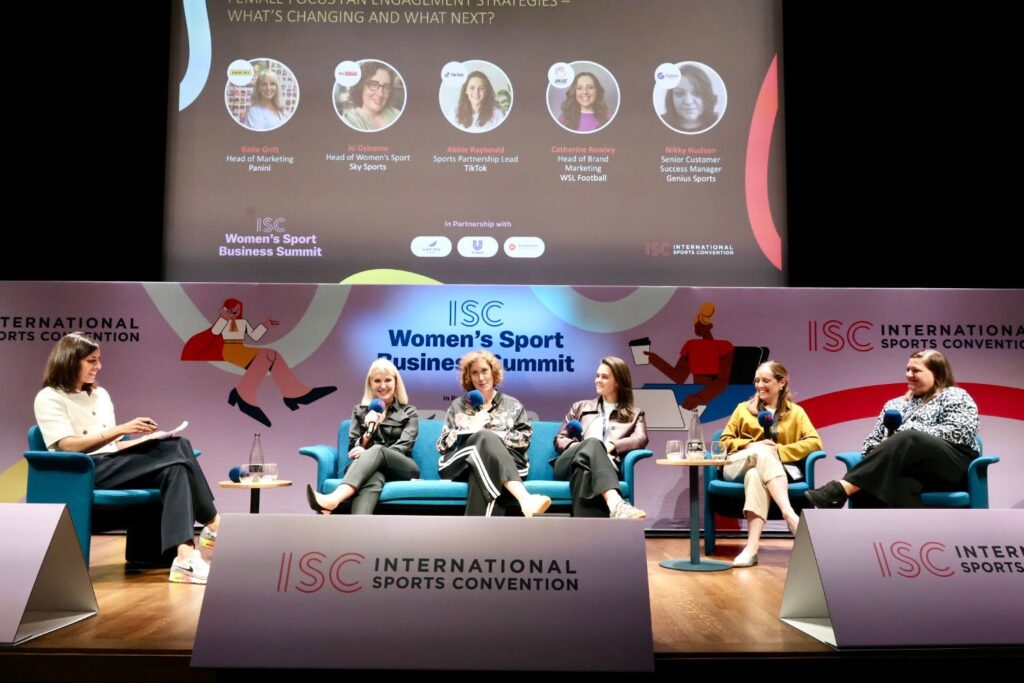
Katie Gritt, Head of Marketing -Panini
Jo Osborne, Head of Women’s Sport -Sky Sports
Abbie Raybould, Sports Partnership Lead-TikTok
Ruth Hooper, Chief Marketing Officer -WSL Football
Nikky Hudson, Senior Customer Success Manager – Genius Sports
A recurring theme of the 2025 ISC Women’s Sport Business Summit was the need to better understand women’s sports fans – and it was on this topic that the day concluded.
The growth of women’s sports properties has created more and better opportunities to interact with audiences – often challenging earlier suppositions.
As Panini Head of Marketing Katie Gritt explained, the customer base for WSL sticker albums has moved from a hardcore of women’s followers to a more general football fanbase. At Sky Sports, Jo Osborne outlined a similar experience.
When it surveyed its audience it discovered a broad cohort who were receptive to women’s sport: 80 per cent of viewers were interested in male and female competitions.
The panel still identified some subtle differences between men’s and women’s sports fanbases. Women’s sports fans tend to be younger, which makes them likelier to exhibit archetypal Gen Z behaviours like following players from club to club.
At the WSL, Catherine Rowley explained, there is also a desire to embrace the change that women’s football represents. A recent rebrand leans into the distinctiveness of the competition and its players, with a lively visual identity inspired by the concept of a new wave.
Together with the WSL, Sky Sports has also reorganised its weekend schedule to better cater for women’s football audiences. The flagship TV matchday slot is now 12pm on a Sunday – chosen because it appeals to home viewers without hampering attendances, and leaves room for build-up and personality-focused content in pre-game programming.
On TikTok, according to Abbie Raybould, personality goes a long way. But the social platform is also helping women’s sports organisations drive discovery into fandom, making it easier for fans to find sports pages from their favourite athlete accounts. Its ambition is for users to only need three clicks to go from an algorithmically served ‘for you page’ post to a sports partner’s owned and operated account.
Genius Sports, said Nikky Hudson, is offering up data to incoming brands to help them learn when fans are engaging with women’s sports content. This is generating opportunities to reach fans at the right moment. The next step is to build this data into more individualised journeys in women’s sport.
Sky Sports has an ever-bolder vision for its women’s sports coverage – an ambition exemplified by its tennis product. With deals in place for the US Open alongside WTA and ATP events, it has employed gender-balanced on-air teams who are comfortable analysing men’s and women’s matches. It has a similar target for other sports but the important thing for now, Osborne says, is to create appropriate spaces for fans: WSL video content, for example, now enjoys its own channel on YouTube.
Originality and imagination are paramount. On TikTok, noted Raybould, sports bodies are finding that collaborations with platform-native creators can reach new fans in unexpected spaces.
Gamification will also be vital to establishing a two-way relationship with fans, said Nikky Hudson. The future for women’s sport is about finding audiences, as well as serving them.