
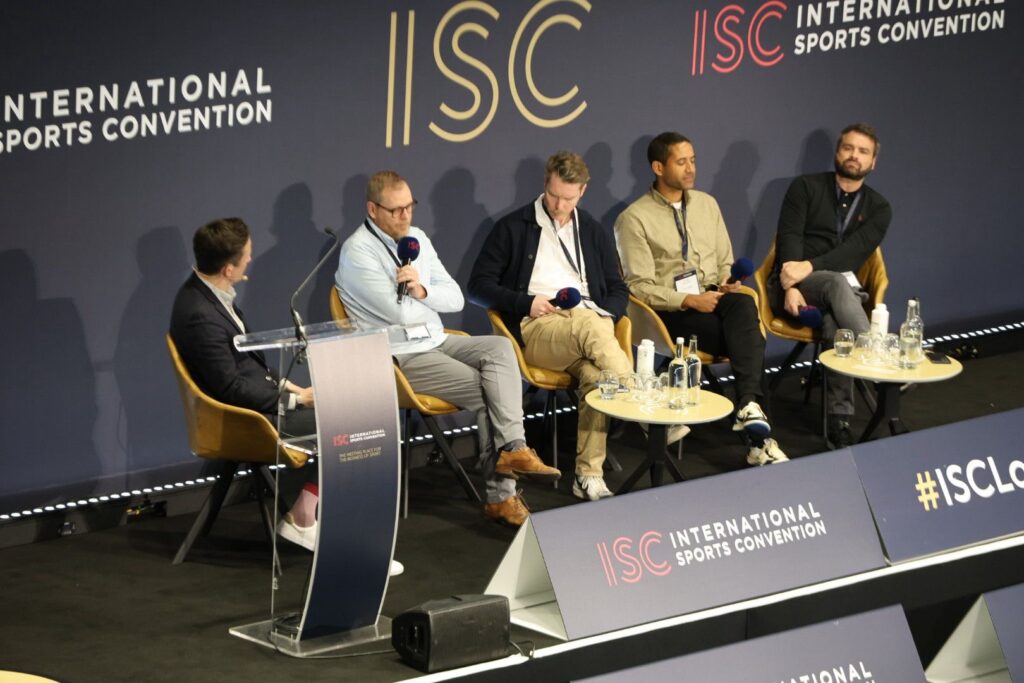
Daniel Barker – Managing Director of Content Strategy and Distribution – NASCAR
Edward Jones – Senior Director of Content Partnerships – PGA Tour
Ryan Skeggs – Managing Director, THE·TEAM
Jem Maidment – Chief Marketing Officer – Utilita Energy
With its emphasis on community and emotional resonance, sport is increasingly understood as a storytelling business. That trend was explored in depth on day two of ISC 2026.
A panel session on the main stage gathered the perspectives of two rights holders, an agency and a brand on a crucial and evolving challenge.
A key lesson for US motorsport series Nascar, according to Daniel Barker, has been in understanding the importance of platform dynamics. YouTube, for example, has gone from “a warehouse for all of our content” to a demanding greater strategic focus.
While race action still dominates the time of most Nascar fans, Barker’s team is now more considered in “feeding the algorithm” – experimenting with everything from thumbnails to the number of camera angles used in the opening seconds of a video.
The PGA Tour, said Edward Jones, has invested in a bespoke studio to make different kinds of in-house programming possible – from more conventional formats to immersive experiences with Tiger Woods. However, audience-building is a collaborative process – whether with digital creators or studios like NFL Films, which is producing the Chasing Sunday series for the tour.
Jones and his team are also responding to considerable audience upheaval in golf. That includes the disruptive entry of LIV Golf, which has drawn star players elsewhere and given fans another flavour of the game to choose from, and the tastes of a huge influx of new casual players in recent years.
These incoming participants, Jones noted, might be likelier to follow the game through a YouTube creator than a top 20 player. With endemic brands and emerging brands also doing things in a “much more creative way”, the options for golf content keep expanding.
THE-TEAM’s Ryan Skeggs put that competition for attention into perspective. The average sports fan, he revealed, scrolls through the equivalent of “1,100 to 1,200 feet of content” on their phones every day – adding up to three marathons’ worth each year.
And while THE-TEAM can assess data to help rights holders and sponsors pinpoint where content should be going out and when, it is up to the creators of that output to understand why it matters to their audience. The pivotal thing, he said, is that fans are seeing output that moves them when it turns up in their feeds.
Utlita Energy, said Jem Maidment, has a strong sense of its consumer base. Because of how much energy it distributes through pre-paid meters, he explained, it has a greater proportion of customers from lower-income communities.
That has deeply informed the stories it aims to tell through its sponsorship of football clubs across the UK. These often concern the challenges of grassroots football, from the existential struggles of teams at that level to the Football Rebooted campaign, which tackles the problem of amateur players being unable to afford new boots.
That project is fronted by former England goalkeeper David James, who Maidment said had committed to the issue because of his familiarity with the issues involved. This, argued Skeggs, was a strong point: athletes are not always in a position to make appearances for values-based reasons, rather than financial ones.
The exceptions can often be found in women’s football, Skeggs added, where players are often closer to their fanbases and the causes that resonate with them. That will deliver commercial returns over time.
The value of personalities in storytelling cannot be understated. Jones talked up the importance of working with PGA Tour golfers to develop their confidence and competence in making content, helping to unlock new ways of telling their stories.
Meanwhile, Nascar is collaborating with YouTube motorsport creator Cletus McFarlane, following his attempts to become a professional racer through the fifth tier of its championship. Interest from his audience has had a huge impact on Nascar’s official accounts but Nascar is also pulling from McFarlane’s experience to help its drivers learn new creative skills.
The incentives on social platforms, in particular, can make cruder attention-grabbing tactics attractive. However, Skeggs made the case for staying true to an organisation’s values and identity in capturing audiences, even if that means trading short-term impact for the right long-term fit.
For Utilita, that might play out through a difficult storytelling environment in the months ahead. If the conflict in Iran continues, it is likely to force up consumer energy prices. But Maidment sees that as a moment to spotlight Utilita’s long-term commitment to energy independence through renewable solutions, which has seen the company help clubs across the country install solar panels at their training grounds.
Identity is also important, with storytelling sharpened by a point of distinction. With Formula 1 making a bigger impression on its shores, Barker explained, Nascar has leaned back into ] historical qualities like approachability, access and Americana. The message, he said, is simple: “We’re big, we’re loud, we’re brash and we’re here for everybody.” In the end, Skeggs said, brand storytelling comes down to a value exchange. Brands and rights holders are ultimately concerned with a financial target – a transaction with fans through a direct sale or shared data. Their audiences will inevitably expect
something worthwhile in return.