
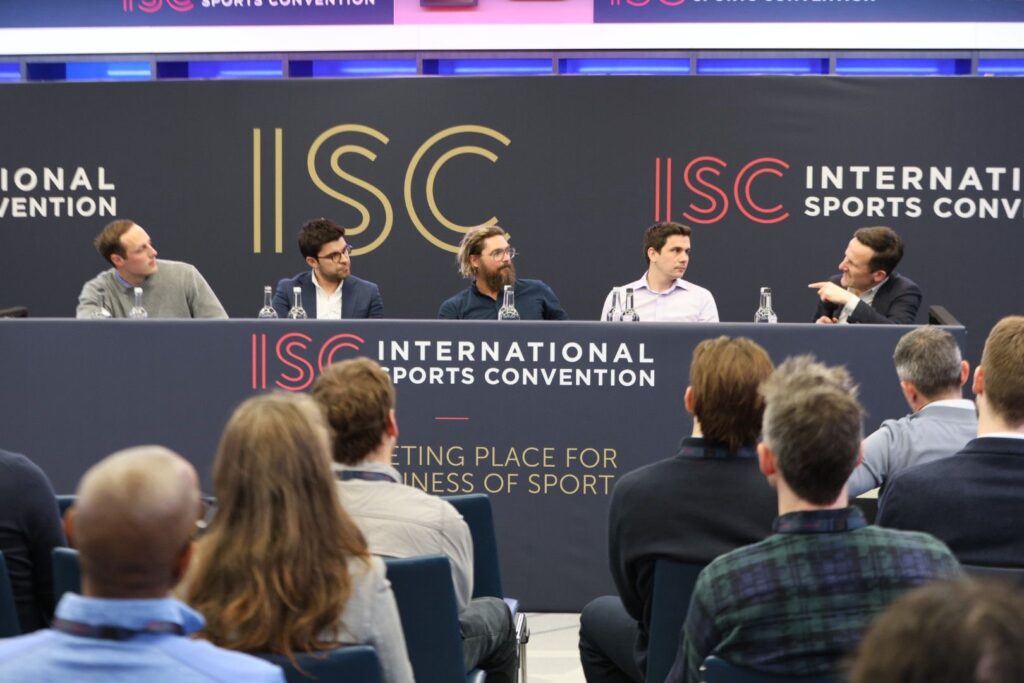
William Haxby – Managing Director – Entourage
George Quick – Executive Director, Commercial – 54
Barrick Prince – Founder/Chief Product Officer – Creator Sports Network
Tom Julian – Head of International Cooperation and Public Relations – Bundesliga International
The creator economy has transformed sponsorship and marketing channels in sport. And increasingly, as the penultimate session of ISC 2026 set out, its influence is being brought to bear on broadcast markets as well.
In one important sense, for Creator Sports Network founder Barrick Prince, this is a matter of audience scale and expectations.
Younger audiences, he said, have grown up being able to experience content digitally – sharing, liking, commenting and communicating with its originators. For them, he argued, the value proposition of traditional broadcasts is lacking.
To reinforce his point, Prince asked ISC delegates in the NFL Locker Room if any would trade him an iPhone for a 1970s rotary handset.
With no one willing to make the deal, he said: “If you’re in the traditional media business, why are you asking this audience to use a rotary telephone?”
Creator Sports Network carries live watchalongs of sporting events with creators “from every country in the world”. It is a “social and scalable” experience that he compared to having “millions of friends on a couch”.
Rights holders have begun to take notice. German football’s Bundesliga has carved out a piece of its Canadian media rights package for the company, mirroring creator-led partnerships it has struck in markets including the UK. For Tom Julian, this adds a complementary layer of engagement for a younger demographic that the league does not expect to find through traditional television.
Prince is comfortable with Creator Sports Network taking its place alongside conventional sports broadcasters in the Bundesliga’s portfolio. “We’re really pitching this as an ‘and’ strategy,” he said, “not an ‘or’ strategy.”
54’s George Quick sees creator partnerships as a means of harnessing the potential of an existing audience to build reach. Reflecting on 54’s work in developing LIV Golf, he recalled having to think about how to build a viewership from scratch, and the capabilities that different channels offer in supporting that aim. Creators, he said, can deliver an impact “from day one”.
In a fast-changing media era, said Entourage’s William Haxby, the creator economy offers a reminder that there are more routes to reaching audiences than ever before – and monetisation opportunities that range from advertising to community-tailored merchandising. He also pointed to the possibilities that are emerging through AI-enabled coding.
This, he said, was now making it feasible to build digital products and take them to testing within 48 hours. That will give creators the potential to develop owned platforms around their audiences and integrate activities that fit their interests. For example, an app designed for a golf creator could include the option for users to organise and log games, spinning up playing data that could serve as a highly valuable “Wayze of golf” for course operators.
The reevaluation of creator channels has changed their relationship with rights holders in other important contexts. Prince noted that where user-generated content platforms like Justin.tv – the forerunner to Twitch – had once been havens for pirated content, creators could now help combat piracy by offering greater value through their watchalongs.
Both Quick and Julian agreed that joint ventures between creators, rights holders and media companies would be central to sports broadcast strategies moving forward, with creators gaining highly appealing content and in turn driving audiences towards other broadcast platforms.
And with digital channels delivering much richer and more granular viewer data than traditional television, Prince also expects the monetisation opportunities for rights holders to develop rapidly. Emerging sports properties, he said, should even consider putting these direct-to-consumer channels at the core of their approach.
With top-tier rights fees still growing, he warned, leagues like the NFL and Premier League were absorbing an ever-larger share of media companies’ sports budgets – meaning the path to a conventional broadcast rights deal could now be closing for smaller organisations.
The time to try something different may already have arrived.