
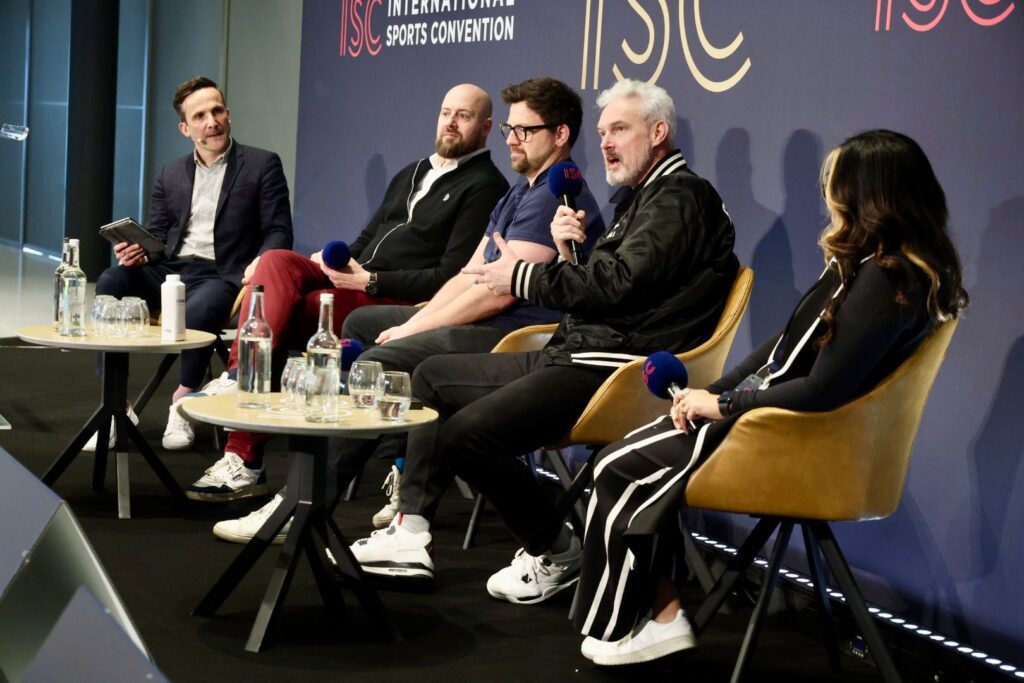
Andreas Heyden – CEO – Dyn Media
David Slade – Senior Director Brand and Marketing – ATP Tour
Chris Ewing – Owner – Caledonian Braves
Divya Goel – Vice President of Fan Engagement – Atlassian Williams F1 Team
Day two of ISC 2026 began on the main stage at the Tottenham Hotspur Stadium with a panel discussion about reaching fans in fast-changing media and cultural spaces.
A prevailing theme of the session was that fandom increasingly takes different forms and originates from an ever-wider range of sources.
Chris Ewing, owner of lower-tier Scottish football club Caledonian Braves, took the stage wearing an FC St Pauli jacket and expressed his admiration for the example set by the Hamburg-based Bundesliga side. In many cases, he noted, wearing the ‘Kult’ club’s merchandise was more an expression of shared values than sporting interest.
Divvya Goel explained how Atlassian Williams F1, operating in a sport with a diverse global fanbase, wanted to give fans the chance to follow the team in their own way. Williams, she said, had often been a “second team” for F1 fans due to its rich heritage, but was eager to inspire more dedicated supporters.
The Netflix series Drive to Survive has stimulated different kinds of Formula 1 fandom – defined by off-track storylines and personalities as much as race action – and Williams has been running with that trend. It has created space for stories about team members like mechanics – showing fans, for example, what it takes to rebuild a car that has been damaged in practice on a race weekend. All of this, it hopes, will
also be part of a broader narrative about Williams’ return to the top of the sport.
The team has also established its app as an always-on point of contact and content hub. “Social is great,” Goel said, “but social is rented space.”
That task of developing digital audiences independently was also taken up by Dyn Media’s Andreas Heyden. It has developed an “anti-social social” strategy that does not ignore third-party platforms but aims to draw audiences towards owned channels.
Dyn Media is a streaming platform dedicated to sports outside football. “23 million Germans love football,” explained Heyden. “20 million love our sports.”
That status, Heyden suggested, allows Dyn to “slice and dice the content in a different way”.
Its attitude towards AI is one example. Dyn uses AI to automate content creation, elevating coverage of smaller sports on its platform that may not have reporters covering them. It also distributes AI-generated highlights to clubs, players and leagues for immediate publication on their channels – building interest that ultimately brings audiences back to its streams.
“We have more of a sandbox for innovation,” Heyden said.
For the ATP, according to David Slade, one important factor has been acknowledging how new tennis fans are entering the sport through an interest in players.
Content partnerships with the likes of TikTok, Spotify and Overtime all help the ATP
to meet fans where they already are. Meanwhile, original content series like Number
One Club – set to tell the stories of all 30 ATP Tour world number one players to date
– will create additional editorial value.
The ATP Tour is a year-round, global product but Slade pointed to some dislocation in how tennis content reaches fans. The tour is fostering dialogue with promoters and Grand Slams to help fans follow players through the season. “There’s a theory around ‘proximal fandom’ in tennis – that you become a fan of tennis when it’s in your back yard,” Slade added. On-the-ground teams at tour events have scaled up considerably since Covid, he said, but a vital objective is making sure that a European fan who attends a local event will follow the next one
across the world a week later.
With so few fans able to attend Formula 1 races, Williams designs its own in-person events in downtown areas, with gamified experiences that generate data and foster a connection through the rest of the year.
For Caledonian Braves, however, the equation is quite different. After establishing their new identity, they faced a tough battle to find fans in Glasgow – a city dominated by the Old Firm of Celtic and Rangers – so Ewing sought instead to build a global following.
The club developed Brave Calling, a documentary now streamed by STV about their pursuit of a place in the Scottish Professional Football League pyramid. As the originator of the club, rather than a custodian, he is also the authentic face of content that reaches curious audiences everywhere.
The Braves also offer fans the chance to join their journey by buying micro-shares in the club – an opportunity taken up by followers in unlikely places around the world.