
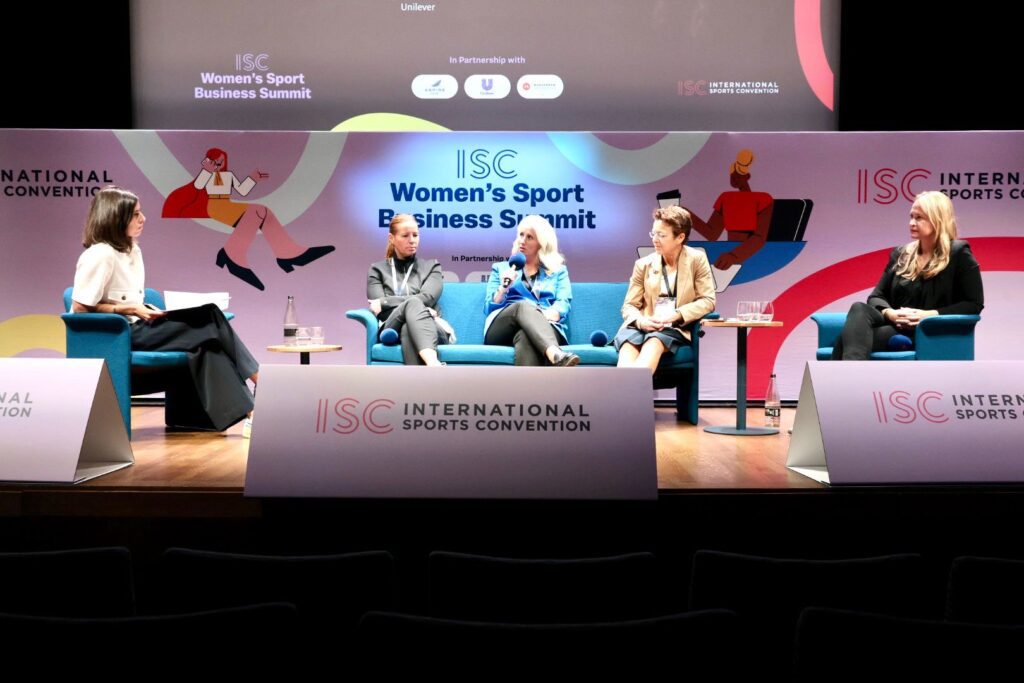
Kerstin Lutz, Chief Executive – Billie Jean King Cup
Ashley Goldie, UKI | Senior Media & Content Manager – Personal Care-Unilever
Sarah Lewis, OBE, OLY, Chair – British Olympians Association
Lenah Ueltzen-Gabell, Group Managing Director – Wasserman
Much of the recent growth of women’s sport has come directly from showpiece events.
This year, major tournaments in football, rugby and cricket have been further markers of that progress. To continue it, though, organisations in women’s sport need to identify the opportunities that are being created.
That begins with maximising the potential of the events themselves. As its chief executive Kerstin Lutz explained, tennis’ Billie Jean King Cup has moved from November to September to better appeal to leading players, many of whom were heading into their end-of-season break when the previous slot came around.
To get that earlier scheduling to work, the organisers also had to think carefully about where the tournament was played. After working with the WTA, they settled on Shenzhen, China – minimising disruption for touring stars by following the Beijing Open.
Giving athletes the right conditions to perform is the first step in the process. As the British Olympians’ Association chair Sarah Lewis noted, it is then up to media companies to provide the stage. She celebrated the huge strides made in the UK to better cover women’s sports events in the past decade – especially the contribution made by the BBC.
That, she said, had delivered proof of the audience for women’s sport, turning sponsorship from an EDI play to a smart piece of business.
Understanding audiences
Unilever’s Ashley Goldie spoke of the role brands and businesses play in adding to the noise around major events through their support.
Now, however, they are thinking more carefully about how they show up in their ‘activation moment’. They must acknowledge the different appetites of women’s sports fans who might value an alternative experience, and the different categories of fan – such as the ‘mum who shops for the family’ – who are underserved in men’s sport.
Lenah Ueltzen-Gabell of Wasserman echoed that point. Rights holders and brands, she said, should take the same time to learn about and categorise women’s sports fans as they do for men’s sports fans. They must also go into each partnership with a full sense of their intended outcome – whether they want to be better known, liked, or loved by their prospective audience.
Wasserman’s data, she added, showed female consumers are typically busier than men – with 13 per cent less leisure time. That leads them to value their sporting experience in the round, whether they are taking young families or spending rare time with friends.
Brand consideration and consumer behaviour are other important factors. Lewis recalled a conversation from her time at the International Ski Federation (FIS), where a timekeeping sponsor had revealed that 85 per cent of watch-buying choices were made by women, either for themselves of for men.
Similarly, Goldie added, many categories of men’s Unilever products are often bought for households by women.
Society and values
With their bigger, broader audiences, major events multiply the societal impact of sport.
That is where the real work of mining that value begins.
Young girls inspired to participate in sport might not continue through adolescence, Goldie noted, with body image and other pressures making them feel less comfortable in that setting. Unilever has been building campaigns to help reverse that trend, working with the likes of Lionesses icon Lucy Bronze.
Goldie and Lewis agreed that sport can provide a different range of role models to those young girls are offered in other media spaces – with different body and personality types represented. As Ueltzen-Gabell added, that can also help boys and young men with their social development by encouraging them to be inspired by women, rather than objectifying them.
Female football players, Goldie argued, are often more comfortable talking about a broader range of topics, from their own career experiences to same-sex relationships and social issues. Clubs, brands and associations have a responsibility, she said, to foster a similar dialogue between male players and their young supporters.
And the legacy of women’s sports events is felt by older fans, Lewis noted, as well as the young. She reflected on her visits to Arsenal women’s games at the Emirates Stadium, where many older supporters have rejoined the club community.
As Lutz suggested, the main event itself is never enough. Organisers and their partners must put in the supporting work, from satellite events to grassroots engagement, to leave an enduring impression.