
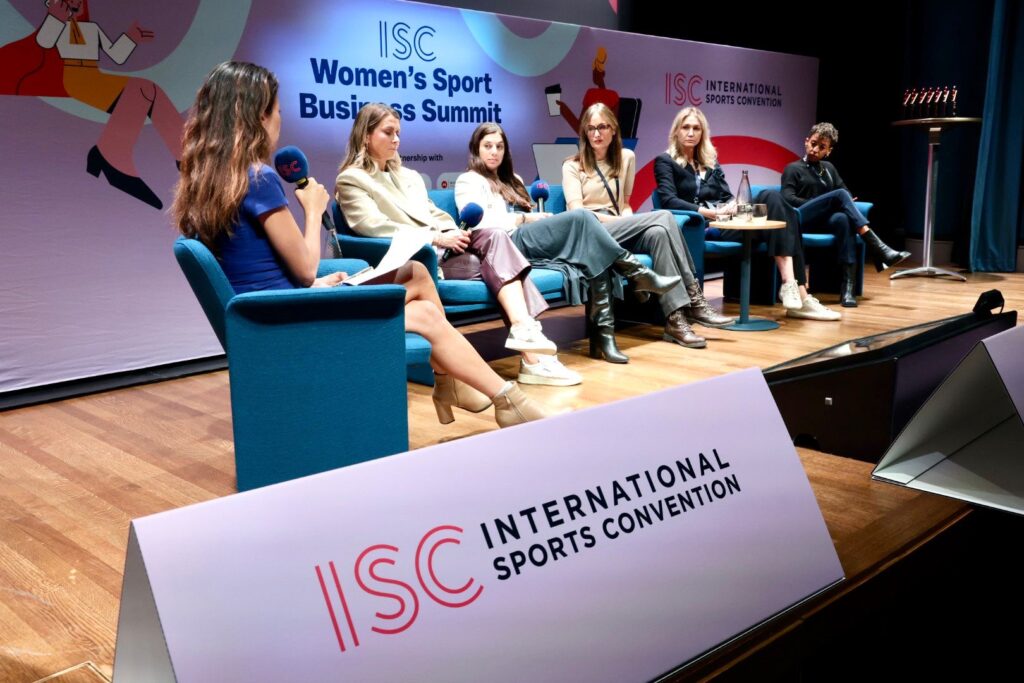
Fiona Morgan, Chief Purpose Officer – SailGP
Lindsey Eckhouse, Chief Revenue Officer – Mercury/13
Karen Dobres, Author and former Board Member/Co-Owner – Lewes FC
Elizaveta Bracht, OLY, Former Olympian Volleyball Player, former FIVB Executive,Co-Founder-Bracht Consulting
Sarah Gregorius, Senior Director, Sporting – National Women’s Soccer League (NWSL)
Sports fans have grown used to celebrating female excellence in recent years – but women’s sport is still facing down the headwinds of cultural legacy.
SailGP, explained chief purpose officer Fiona Morgan, has mixed-gender teams on the water. The wider sport of sailing, however, is a sport that has been historically dominated by men, especially those who design and pay for it.
Lewes FC were the first English football club to offer equal pay to their men’s and women’s teams – along with equal access to training pitches and presentation on social media. Yet succeeding in that goal, Karen Dobres recounted, meant persuading fans that the men’s team would not suffer as a consequence.
The club also rallied support from female fans, developing campaigns and driving up attendances by creating more unconventional experiences.
When the FIVB commissioned research into its fanbase in the 2010s, revealed Elizaveta Bracht, it found that 49% of its fans were female, 84% were interested in men’s and women’s volleyball, and the media value of women’s games was often higher. That drove it to relaunch its core event offer and equalise prize money.
These expectations are not uniform across different territories. In the US, the NWSL is midway through an enviable set of four-year media rights deals worth $240 million. And the league has an important advantage.
“If you ask an American fan to close their eyes and picture excellence in football,” said NWSL senior sporting director Sarah Gregorious, “they will picture the women’s game.”
The NWSL also exists as a wholly separate property from men’s Major League Soccer – something Gregorious sees as a key differentiator for investors in American women’s football. It also incentivises those investors to focus solely on growing the women’s game.
At investment group Mercury/13 – majority owner of Italian side Como and England’s Bristol City – the operating thesis is also grounded in distinctive presentation and audience positioning for women’s teams. Still, Mercury/13, has also noticed differences in the scale and maturity of fanbases for women’s football in England and Italy – even though both are heartlands for the men’s game.
For Fiona Morgan, in an era where sponsors are reliant on female athletes and their stories, sports brands have a responsibility to the development of those athletes. The biggest obstacle for SailGP is securing training time for female sailors time in its unique boats, and support for that task is highly valued.
The championship also wants to develop pathways for high-performance careers off the water, as there are no female lead coaches or CEOs among SailGP teams.
The same challenge is evident in volleyball, said Bracht. She pointed to the lack of women in leadership roles in the sport, and the fact that only four per cent of elite volleyball coaches are female.
Back on the field, Gregorious believes there is an urgent need to address the gap in physiology and psychology research between male and female elite professional athletes. Women’s high-performance needs, she said, are not well enough understood.
The sports industry, Eckhouse added, does not yet understand female fans very well either. 80 per cent of household spending is led by women, she noted, but few sports brands have a proper grasp of their relationship with those consumers.
Ultimately, however, Eckhouse returned to the issue of perception. The participation gap between girls and boys, she said, still begins as early as toddlerhood. Developing a culture where female athletes are the norm can start there.