
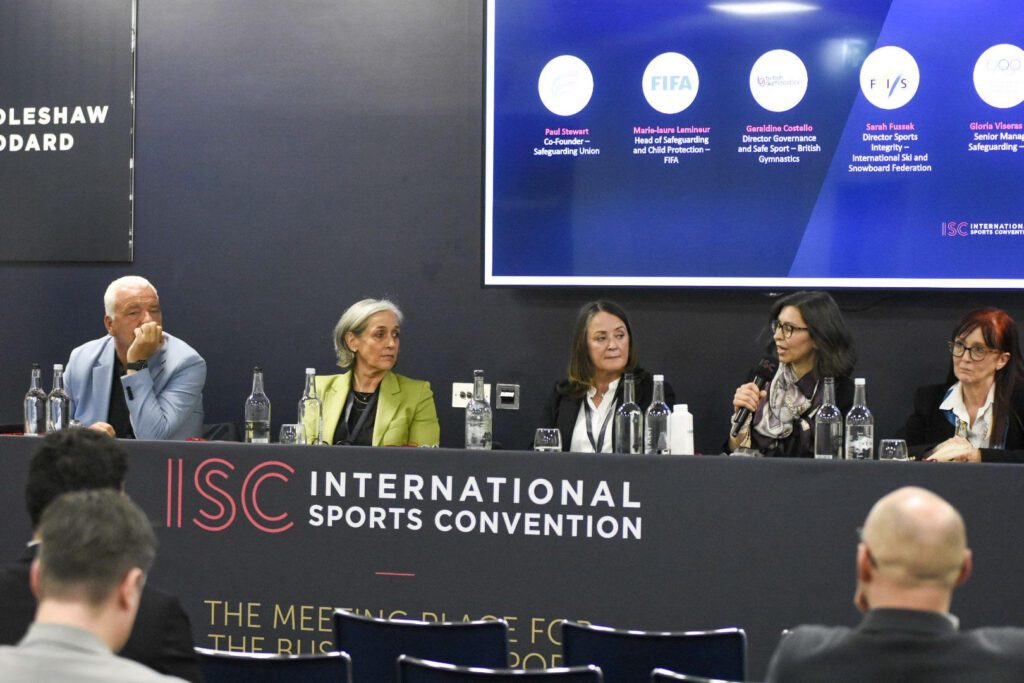
Paul Stewart – Co-Founder – Safeguarding Union
Marie-Laure Lemineur – Head of Safeguarding and Child Protection – FIFA
Geraldine Costello – Director Governance and Safe Sport – British Gymnastics
Sarah Fussek – Director Sports Integrity – International Ski and SnowboardFederation
Gloria Viseras OLY – Senior Manager Safeguarding – IOC
Sport inspires joy, hope, and the pursuit of the highest ambitions.
But spaces where young people seek community and an outlet for self-expression can – in the most unfortunate cases – attract those who search out human vulnerability.
The final day one session of ISC 2026 in the Briefing Room confronted the difficult and complex matter of safeguarding in sport, exploring the measures that can be taken to shut down threats of abuse.
“Harm evolves,” said FIFA’s Marie-Laure Lemineur. Sports bodies must be attuned, she explained, to the different tactics used by predators and the different risks to which young people are exposed. That can be a huge challenge for smaller organisations with more limited resources, necessitating better cooperation and information-sharing across the industry.
British Gymnastics’ Geraldine Costello stressed the importance of listening – taking on the difficult lessons of survivors while also grasping the needs of the community. Costello is currently leading a governance review at the governing body, trying to find out how to build confidence in safeguarding protocols among those running grassroots programmes, while looking for oversights and weaknesses across the
board.
The risks, however, run to the very top. “Safeguarding capability is tested under pressure,” said the International Ski Federation’s (FIS) Sarah Fussek, laying out how the stresses of major events stretch best practice to its limits. That makes it even more important to consolidate safeguarding procedures and ensure open communication channels between all stakeholders.
The IOC, said Gloria Viseras, has taken a series of steps to protect athletes, ranging from pre-event policy to the use of ‘mind zones’ – primarily there to help Olympians relax and disconnect in the days before competition – as safe spaces. She also emphasised the value of including abuse survivors in the design and review of safeguarding best practice.
One such survivor was on the panel at ISC 2026. Former Tottenham Hotspur star Paul Stewart went public ten years ago with his experiences of child sexual abuse in youth football. He believes it is essential to create an environment where children are empowered to speak up about abuse – something he says was not true of the 1970s – but accepts that this can still feel impossible for some due to the ways predators
isolate their targets.
He is now the co-founder of the Safeguarding Union, and tours football clubs sharing tools and information. Education remains essential, he said. But while coaches and staff engage readily with his sessions, it can be harder to reach families.
“Parents still have that mindset that it happens somewhere else; it doesn’t happen in this place,” he added. “That leaves you very vulnerable.”
Stewart is concerned that safeguarding is less of an institutional priority in other countries he has visited – but also flagged the relative lack of interest among the industry community at ISC 2026 compared to more commercially centred topics.
Nonetheless, Costello spoke positively of pursuing actions that carry an impact. She noted that her role only existed because a leader at British Gymnastics had committed to it and revealed that the body was now seeking a non-executive director with lived experience.
Multi-layered governance structures often complicate safeguarding in sport, limiting the powers of even a well-resourced international federation like FIFA at a local level. For Lemineur, that means organisations must understand their sphere of influence but also act wherever they have the capacity.
Meanwhile, the threats to those in sport continue to evolve beyond the scope of classical safeguarding. Fussek cited online spaces as an example of how quickly this can happen. Every risk assessment, she said, now needs a social media component, and sports bodies must build up broad-based expertise and response capabilities. The first question many athletes ask after discovering online threats is often a complex one: “Am I safe?”
Visseras reiterated the growing scale of online abuse detected by the IOC. Using an automated tool that monitored millions of social media posts, it found that 353 athletes and officials were affected at Paris 2024, with over 10,000 messages confirmed to be abusive. So far, the IOC has already found 3,000 more abusive messages directed to Olympians at Milan-Cortina 2026, despite the Winter Games featuring a third as many athletes.
These hateful messages, Lemineur added, are part of “a continuum of abuse”: a manifestation of the feeling held by some that they can act towards athletes with impunity, online and offline.
As with so many other safeguarding issues – from protecting grassroots welfare officers against isolation to accelerating judicial processes when complaints are raised – collective action will be at the core of any effective response.