
Miwa Sykes, Lead Consultant – Two Circles
Sophie Paine, Lead Consultant – Two Circles
It will have surprised few delegates at the ISC Women’s Sport Business Summit to learn that women’s sport is growing fast.
Nevertheless, the pure numbers shared in a presentation by Two Circles’ Miwa Sykes and Sophia Paine put that journey into some perspective.
Global revenues from elite women’s sport grew from $981 million in 2023 to $1.88 billion in 2024. They are projected to leap again to $2.35 billion in 2025.
Meanwhile, the volume of new investments in women’s sport more than doubled from 2023 to 2024.
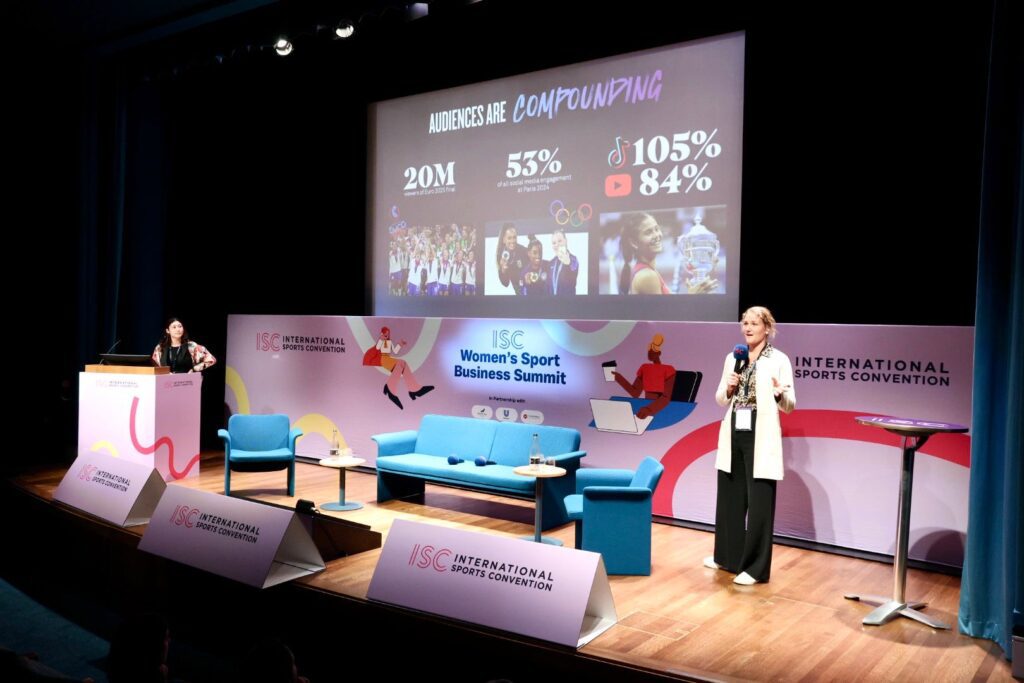
That growth is being driven by compounding audiences. There were 20 million viewers for the UEFA Women’s Euro 2025 final, while 53 per cent of social media engagement at Paris 2024 was generated by female athletes. In the first half of this year, the followership of top female athlete accounts on TikTok grew by 105 per cent.
Inevitably, that is unearthing some massive commercial opportunities. To make the most of them, Skyes and Payne recommended three considerations for the future: ‘know your fans’, ‘leverage talent’ and ‘triple your genres’.
Know your fans
As women’s sport grows, organisations like Two Circles have been able to capture more and better data about its fanbases.
The headline figures indicate women’s sports fans are typically younger, more gender-balanced, more family-oriented, and newer to their game or community.
In other words, women’s sport has a distinct audience from men’s sport – so it needs to be treated as a separate product.
That can mean developing unique experiences for women’s sports fans, like ‘bottomless brunch’ themed hospitality when WSL champions Chelsea play at Stamford Bridge.
Or it can mean activating with purpose and centring conversations that are overlooked elsewhere. Skyes and Payne cited IDA and Guinness working on specialist footwear for women’s rugby players, Persil’s campaign with Arsenal on the double standards around blood stains and menstruation in sport, and WSL sponsor Nike funding goalkeeper gloves and football boots for players without personal endorsement deals.
Leverage talent
Female athletes are carving out their own spaces in the media ecosystem. Ilona Maher is billed on Wikipedia as ‘social media personality, reality television star, and American rugby union player’ – in that order.
Women’s sports fans are likelier to follow their favourite athletes first and foremost – a tendency that mirrors the interests of younger fans. Two Circles has found that 17% of Gen Z supporters are ‘most drawn to a sport by individual athletes’ compared to 10% of boomers and 14% of millennials.
The upside for brands here is considerable. Female athletes score higher than their male counterparts on positive associations like being ‘trustworthy’, ‘inclusive’, ‘progressive’ and ‘inspiring’.
Rights holders, meanwhile, can also leverage the power of their biggest names. In the WNBA, the ‘Caitlin Clark effect’ has driven exponential growth in the brand value created on social media by all team and league accounts since her Indiana Fever debut in 2024.
Triple your genres
To stand out in modern media, women’s sports properties must trade in the ‘for you’ economy, learning what content is served to consumers by social media algorithms.
Brands and rights holders have to understand where their IP shows up across their own sport, generalist sports content, and a range of other cultural environments.
They must also think about where new prospective fans are and how to reach them: identifying the white space between their brand, their audience, and the new genres where their presence feels natural.
Here, Skyes and Payne pointed to Wimbledon’s success in courting ‘non-attending sport and social fans’. Its smash-hit ‘Overheard at Wimbledon’ social content series is a funny and entertaining window into the world of the Championships, with an emphasis on sunshine, Pimms and banter rather than the tennis itself.
Two Circles has found that women’s sports fans share a core set of external interests: food, lifestyle, travel, entertainment and technology. There are compelling opportunities wherever those interests overlap.